- Format
- Research
- Reading time
- 12 min
- Reading level
- Considered
- Author
- Andreas Rieger
- Published
- 05 November 2026
- Language
- English
- Topics
- Artificial IntelligenceEconomy
Cyprus & AI · Research 02
Cyprus's Digital Strengths and Its AI Adoption Gap
Cyprus reports higher use of several established digital technologies than the EU27, yet enterprise AI adoption remains lower. Research 02 examines company size, industry, reported barriers and individual generative AI use, and the explanations the evidence cannot establish.
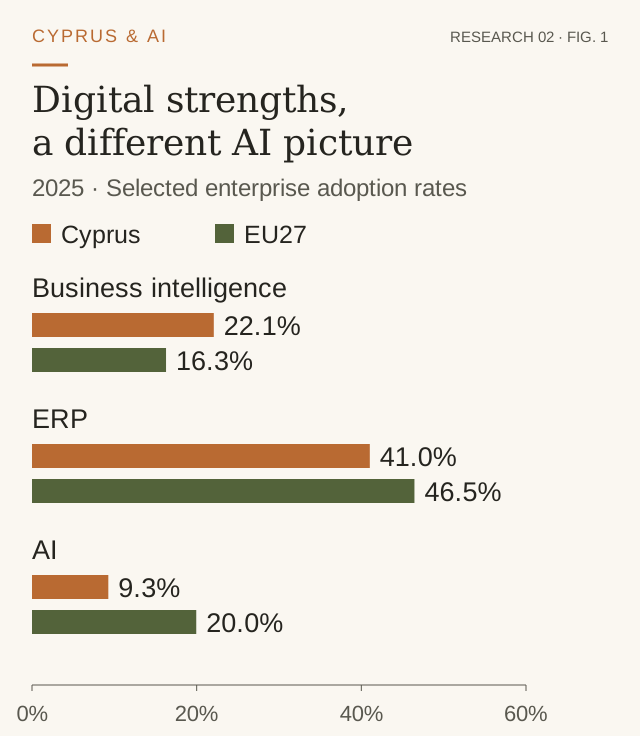
In 2025, 22.08 per cent of enterprises covered by the harmonised ICT survey in Cyprus used business intelligence software, compared with 16.28 per cent across the European Union. Enterprise AI adoption presents a different picture. Only 9.3 per cent of Cypriot enterprises reported using AI technologies, against an EU27 figure of 20.0 per cent.
Cyprus also exceeds the EU27 figures in customer relationship management, data analysis and certain cloud services, although it falls behind in enterprise resource planning and other measures. Its business technology profile is more varied than the low AI adoption figure might suggest.
One possible explanation for Cyprus's low enterprise AI adoption is that businesses have yet to develop the necessary digital foundations. The available statistics make that argument difficult to sustain in such general terms. They also raise questions that national technology adoption figures cannot answer on their own. How much of the difference can be explained by the composition of the business sector, the difficulties enterprises encounter or the capabilities needed to make AI useful in practice?
Digital Technologies and AI Adoption
The 2025 enterprise ICT statistics show considerable variation in Cyprus's position across established digital technologies.
Customer relationship management software was used by 33.10 per cent of Cypriot enterprises, compared with 28.51 per cent across the EU. The proportion conducting data analysis internally or through external providers was 42.84 per cent, against an EU27 figure of 39.85 per cent. Intermediate or sophisticated cloud-service adoption stood slightly above the European figure, at 48.45 per cent compared with 46.69 per cent.
Other indicators tell a different story. Enterprise resource planning software was used by 41.03 per cent of Cypriot enterprises, below the EU27 figure of 46.45 per cent. Paid cloud-service adoption was also marginally lower, at 51.38 per cent compared with 52.74 per cent.
The figures describe an uneven pattern of technology adoption. Cyprus performs above the EU27 level in some categories, below it in others, and substantially further below it in AI.
Digitalisation can be pictured as a progression in which companies adopt business systems, become more sophisticated in their use of data and eventually move into artificial intelligence. The sequence is understandable. Established software may provide useful data, support more structured processes and create opportunities for new applications. Yet the existence of these systems says little about whether an enterprise has identified a worthwhile AI application or possesses the conditions needed to implement one.
For example, a business intelligence platform may help managers examine sales performance without creating a compelling reason to introduce AI. A company might have extensive ERP and CRM systems but face difficult questions about data access, integration or accountability before using AI in a particular process. Another might find a modest AI application useful without having invested in an elaborate technology architecture.
The percentages compared here describe separate aggregate observations. They do not show whether the same enterprises use business intelligence, ERP, cloud services and AI, or how these technologies are combined within individual organisations. A higher national adoption rate for one technology tells us nothing conclusive about whether the companies concerned are prepared to use another.
The adoption of established business technologies is measurable, but organisational readiness for AI encompasses questions that these individual indicators do not resolve. The 2025 Digital Intensity Index also includes AI use as one of its components, so its association with AI adoption cannot be interpreted as independent evidence of AI readiness without accounting for that overlap.
Cyprus's low enterprise AI adoption sits alongside a mixed record in established digital technologies, including several measures of above-average uptake. A broad diagnosis of insufficient digitalisation overlooks much of that picture. The composition of the business sector offers another possible explanation.
Why Company Size and Sector Are Not Enough
Enterprise size is an obvious candidate. Larger companies may have dedicated technology teams, greater investment capacity and more opportunities to spread implementation costs across their activities. Smaller businesses may operate with fewer specialised resources and different commercial priorities.
The harmonised 2025 figures show AI adoption increasing across the three enterprise-size classes. Among businesses employing 10 to 49 people, 7.7 per cent in Cyprus reported using AI technologies, compared with 17.0 per cent across the EU. For enterprises employing 50 to 249 people, the corresponding figures were 15.3 and 30.4 per cent. Among companies with at least 250 people employed, adoption reached 35.1 per cent in Cyprus and 55.0 per cent across the EU.
Larger enterprises report higher AI adoption in both Cyprus and the EU as a whole, yet Cyprus remains below the EU27 figure within every size class. Differences in the proportions of enterprises belonging to those broad groups cannot explain the lower Cypriot adoption rate within each group.
Business intelligence offers an additional comparison. Cypriot enterprises exceed the respective EU27 adoption figures for this technology in all three size classes. The differing international patterns of established technology use and AI adoption are visible among small, medium-sized and large enterprises alike.
A full quantitative decomposition would still be needed to measure how much enterprise size contributes to the national AI adoption gap. The present comparisons establish that the size distribution alone cannot account for the differences observed within the three groups.
Different economic activities also have different opportunities to use AI, along with their own investment requirements, operational constraints and commercial incentives. An economy's industry structure can therefore influence the proportion of enterprises adopting a technology.
Yet the harmonised figures show lower Cypriot AI adoption within numerous comparable economic activities, including information and communication, professional, scientific and technical services, trade and manufacturing.
These differences cannot be attributed solely to the distribution of enterprises between broad industry categories. At the same time, companies classified in the same industry may operate very different businesses, and the present analysis has not performed a full quantitative standardisation of the national sector mix.
Enterprise size and economic structure remain relevant considerations, but their broad distributions cannot explain the differences observed within the matched groups. Understanding what happens within comparable groups requires examining the conditions under which businesses consider and introduce AI.
What the Barriers Actually Tell Us
Some evidence about those conditions comes from enterprises that have considered introducing AI but have not adopted it.
Eurostat asks this specific group about the obstacles they encountered. The resulting percentages refer only to enterprises that had considered using AI technologies but were not doing so. They describe self-reported difficulties within that group, not their prevalence across the entire business population or the results of technical system audits.
A lack of relevant expertise was reported by 68.27 per cent of these enterprises in Cyprus, compared with 70.31 per cent across the EU. Expertise is a frequent concern in both populations, although its reported prevalence in Cyprus is slightly below the EU27 figure.
The position differs for technical compatibility and data-related difficulties. Incompatibility with existing equipment, software or systems was reported by 51.22 per cent of the relevant Cypriot enterprises, compared with 41.60 per cent across the EU. Difficulties concerning the availability or quality of necessary data were reported by 48.11 per cent in Cyprus and 43.51 per cent across the EU.
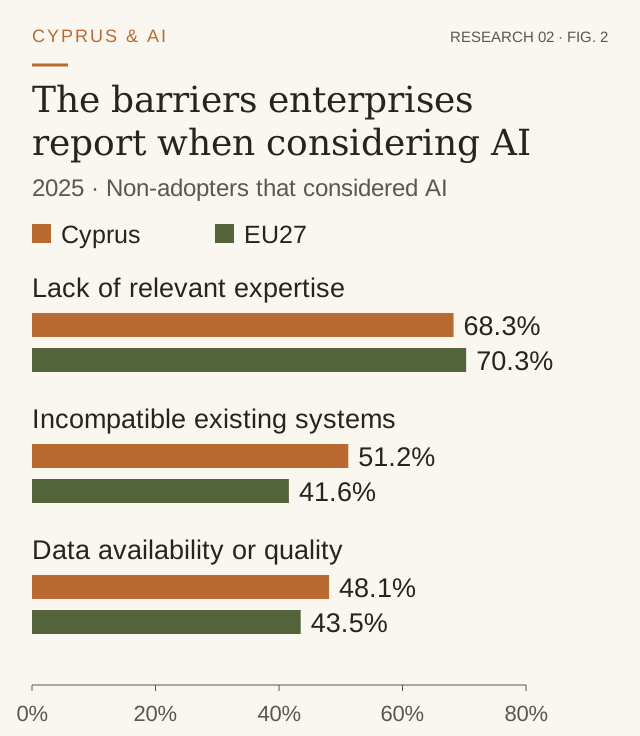
Compatibility with existing systems and access to suitable data therefore deserve closer examination in Cyprus. The expertise figures also demonstrate why a frequently reported obstacle should not automatically be treated as the distinguishing feature of a country's adoption performance.
A business may encounter several problems during the same evaluation. Removing one would not necessarily change its eventual decision, and the survey does not reveal what would have happened under different circumstances. Nor can the responses determine how much each factor contributes to the difference between Cyprus and the EU27 adoption rates.
Organisational integration remains a plausible area for investigation, given the reported compatibility and data difficulties. The findings do not establish that Cypriot enterprises have a specific national integration weakness or that such a weakness is the dominant explanation for their lower AI adoption.
Commercial considerations further complicate the picture. A company may understand the capabilities of AI and still find that available applications offer too little benefit for the investment, operational disruption or risk involved. Another may see a promising opportunity but lack the necessary data or technical resources to pursue it.
Those situations call for different responses. Treating every decision not to adopt AI as evidence of inadequate readiness would obscure the distinction between an implementation problem and a sound commercial judgement.
The survey identifies difficulties that some enterprises encounter when considering AI. Their influence on adoption decisions, and on the national difference between Cyprus and the EU, remains a subject for further research.
When People and Companies Tell Different Statistical Stories
Eurostat's 2025 statistics on individual use of generative AI introduce another dimension to Cyprus's adoption picture.
Among people aged 16 to 74, 44.20 per cent in Cyprus had used generative AI tools during the previous three months, compared with 32.66 per cent across the EU27. The difference also appears in use for professional purposes. In Cyprus, 22.65 per cent of individuals in the same age group reported using generative AI for work-related purposes during the previous three months, against 15.36 per cent across the EU.
Cyprus therefore occupies a different position in the individual statistics from the one seen in enterprise AI adoption. Its measured use of generative AI by individuals, including for professional purposes, is above the EU27 level, while adoption of AI technologies by the enterprises covered in the harmonised business survey is below it.
The two surveys measure different populations and technologies. The individual statistics concern people aged 16 to 74 and their use of generative AI. The enterprise statistics concern businesses within a defined economic and size-based survey population and cover a broader range of AI technologies. Their percentages cannot be subtracted or combined to calculate how many people use AI inside organisations that do not formally report its adoption.
Professional use by an individual tells us little about the organisational setting. A person may use generative AI as part of an approved company process, through a tool chosen independently or in another professional context. The survey does not establish the extent of informal or unauthorised workplace use, nor does it identify which respondents work for enterprises reporting no AI adoption.
Claims of widespread, hidden workplace AI use in Cyprus would therefore go beyond the evidence. The documented finding is that personal use of generative AI and enterprise adoption of AI technologies produce different international comparisons.
An individual can become familiar with generative AI through everyday experimentation, professional tasks or personal interests. Introducing AI within an organisation raises additional questions about the purpose of the application, access to information, reliability, responsibilities and the consequences of using its outputs in business processes.
A useful response produced by a generative AI tool may require little organisational involvement. Incorporating the same technology into a customer service workflow or a process affecting commercial decisions can introduce requirements extending well beyond the skills of the person operating it.
Individual use and enterprise adoption may interact in important ways, but the present statistics do not explain how that relationship works in Cyprus. We do not yet know whether familiarity with AI among individuals influences organisational decisions, or how businesses respond when employees already possess experience with the technology.
Answering those questions would require evidence connecting individual activity with organisational practices and adoption decisions. The current statistics identify contrasting patterns worth investigating without measuring a link between individual use and organisational adoption.
What We Still Need to Understand
Cyprus's enterprise AI adoption figures provide one measure of technology diffusion within the survey population. Several established digital technologies are adopted more widely than across the EU27, while AI adoption remains lower. The difference persists across enterprise-size classes and numerous comparable industries. Businesses report difficulties involving expertise, systems and data, although the causal importance of those difficulties remains unknown.
For business leaders, an enterprise's existing software may provide a useful starting point for an AI application. It may also reveal very little about whether the application makes economic sense, whether the required data can be used reliably or whether the organisation can manage the consequences of introducing it into its operations.
Those questions depend on the business activity and the decisions involved. AI used to support an employee's research raises different organisational considerations from AI incorporated into pricing, customer service or operational decision-making. The presence of digital systems alone cannot settle them.
For institutions assessing Cyprus's digital economy, aggregate adoption rates offer a useful measure of technology diffusion. Explaining the differences between comparable enterprises would require more detailed evidence about their organisational capabilities, investments, intended applications and operating conditions, ideally linking those characteristics within the same businesses.
Such research could help distinguish enterprises facing practical barriers to worthwhile AI applications from those that have found little commercial reason to adopt them.
The economic outcome matters as much as the adoption decision. A higher adoption rate does not guarantee greater productivity, stronger competitiveness or better employment outcomes. The available evidence does not establish a causal effect of AI adoption on Cyprus's national productivity, employment or value added.
Established digital technology adoption tells us which tools businesses have introduced. Enterprise AI adoption tells us whether they use technologies covered by the survey. Neither measure establishes the quality of the decisions behind those investments or the value they create.
Understanding Cyprus's position will require examining the conditions under which enterprises can put AI to work, and whether doing so is worthwhile.
The adoption figures provide a starting point. The economic judgement requires different evidence.
Apparatus
Sources and methodological notes
The enterprise figures refer to the harmonised 2025 ICT usage and e-commerce survey population: enterprises with at least ten persons employed, including employees and self-employed persons, in NACE Rev. 2 sections C–J and L–N and group 95.1. Each general adoption percentage has the number of enterprises in the corresponding survey population or size/industry group as its denominator. These are not adoption rates for the entire Cypriot economy. EU27 figures are harmonised EU aggregates, not unweighted averages of national rates.
Statistical Service of Cyprus. Survey on the Usage of Information and Communication Technologies (ICT) and E-Commerce in Enterprises, 2025.
Eurostat. Enterprise adoption of ERP, CRM and business intelligence, data analysis and cloud computing services, 2025.
Eurostat. Artificial intelligence in enterprises, including enterprise-size comparisons and reported obstacles to adoption, and artificial intelligence by NACE Rev. 2 activity, 2025.
Eurostat. Individuals – use of generative AI tools, 2025. Indicators I_IUAI and I_IUAIWP, population aged 16 to 74. The figures used here correspond to the archived Eurostat data version of 5 June 2026.
For the software, cloud and data-analysis comparisons, the selected indicators are E_ERP1, E_CRM1, E_ITBI, E_CC, E_CC1_SI and E_DA, with unit PC_ENT; the checked data version is 27 February 2026. The AI adoption and industry comparisons use E_AI_TANY and PC_ENT, with the P0-B data version of 15 June 2026. The three barrier comparisons use E_AI_BLE, E_AI_BINC and E_AI_BDDT, with unit PC_ENT_AI_EC: enterprises not using AI that had considered doing so. They use the 15 June 2026 data version. Earlier Eurostat article extracts may show different barrier values.
For both individual indicators, the unit is PC_IND and the population is IND_TOTAL: all individuals aged 16 to 74. Professional use is a share of that population, not a share of employed people or of generative AI users.
The 2025 Digital Intensity Index composition, Table 5, includes AI use among its twelve criteria.
The enterprise and individual surveys use different statistical populations and technology definitions. All international comparisons in this article are descriptive. They do not establish causal relationships between technology adoption, organisational capabilities and economic outcomes.
This research follows What Cyprus's AI Adoption Figures Leave Out, the first contribution to the Cyprus & AI series.