- Format
- Research
- Reading time
- 11 min
- Reading level
- Considered
- Author
- Andreas Rieger
- Published
- 03 November 2026
- Language
- English
- Topics
- Artificial IntelligenceEconomy
Cyprus & AI · Research 01
What Cyprus's AI Adoption Figures Leave Out
Cyprus's official AI adoption figures reveal a substantial gap with the EU. But how much do they tell us about the wider economy? Research 01 examines the survey's boundaries, the economic weight of excluded sectors and the difference between adopting AI and creating economic value.
In the European Union's 2025 enterprise survey, 9.3 per cent of businesses covered in Cyprus used at least one defined artificial intelligence technology. Across the EU27, the figure was 20.0 per cent. A difference of 10.7 percentage points is difficult to ignore. It is also remarkably easy to ask that difference to explain more than it measures.
The comparison suggests that AI adoption among the surveyed Cypriot businesses is considerably less widespread than across the European Union. That is a relevant finding. It deserves examination, especially as companies and public institutions consider what artificial intelligence might mean for competitiveness, productivity and the future of work.
But a national economy is not identical to the group of enterprises included in a technology survey. Nor does the use of a technology necessarily tell us how much it has changed the way an organisation operates.
These questions form the starting point for Cyprus & AI, a new independent research series examining how artificial intelligence is changing the Cypriot economy and the conditions under which it may create lasting economic and human value. The investigation will extend across industries, business structures, employment, education and the institutions shaping the country's development.
It begins with a more immediate question. What can we reliably learn from Cyprus's official AI adoption figures, and what remains outside their field of measurement?
What the Figures Actually Measure
The European Union's business statistics on artificial intelligence are built on a harmonised survey of information and communication technology usage in enterprises. Eurostat coordinates the methodology, while national statistical authorities conduct the surveys using common definitions.
For Cyprus, the results are produced by the Statistical Service, CYSTAT.
This arrangement has an important purpose. International comparisons are meaningful only when the underlying observations follow sufficiently consistent rules. A difference between two national percentages should reflect differences in the measured activity, rather than entirely different interpretations of the question.
Within this framework, the 2025 results are clear. AI use was reported by 9.3 per cent of surveyed enterprises in Cyprus, compared with 20.0 per cent across the EU27.
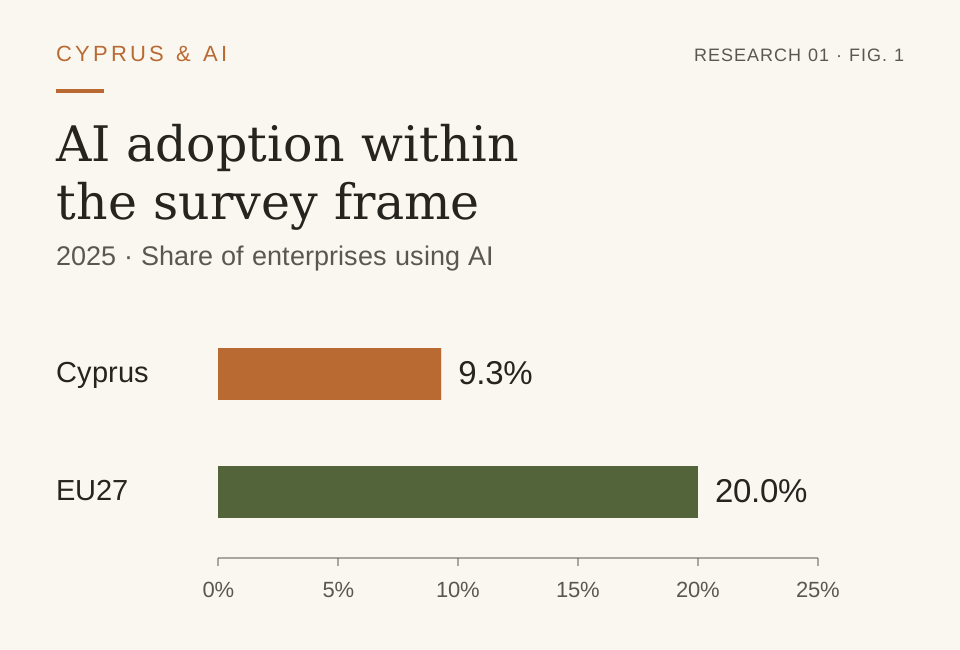
The figures describe a defined statistical population.
The harmonised survey covers enterprises with at least ten employees and self-employed persons in specified economic activities. Its main sectoral coverage includes manufacturing, construction, trade, transport, accommodation, information and communication, real estate, professional services and administrative support, together with certain other activities.
Businesses with fewer than ten persons employed fall outside the regular scope. So do several entire economic sectors.
The definition of AI adoption is equally important. The headline indicator identifies enterprises using at least one of the technologies specified by the survey. These include systems for analysing language, recognising images, generating content, processing data through machine learning and automating certain activities.
The wider survey contains additional information about aspects of AI use, including some purposes and applications. It is therefore more informative than the headline percentage alone.
Nevertheless, the aggregate adoption rate answers a comparatively narrow question. It describes the prevalence of defined technologies among the businesses included in the statistical population.
It does not establish the intensity of their use, the extent to which they have been incorporated into everyday operations or the economic results associated with their introduction.
None of this makes the official comparison misleading. The survey was designed to measure a defined set of activities among a specified group of enterprises. Its international consistency is precisely what gives the results their value.
The difficulty arises when a measure of technology adoption within that group becomes a shorthand for the technological transformation of an entire economy.
To understand the difference, we need to look beyond the survey's boundaries.
The Economy Outside the Frame
The structure of the Cypriot economy provides an important reason to examine those boundaries more closely.
Economic activity is distributed across industries and institutions with different operating models, workforce structures and relationships to technology. Some fall within the European enterprise survey. Others are excluded by design.
Among the fully excluded sectors are financial and insurance activities, public administration, education, human health and social work, agriculture, and arts, entertainment and recreation.
These are not peripheral activities simply because they sit outside a statistical instrument designed for other purposes.
An independent analysis undertaken for this research series, based on CYSTAT's revised national accounts, found that approximately 29.9 per cent of Cyprus's gross value added in 2025 originated in economic sectors entirely outside the scope of the harmonised Enterprise ICT survey.
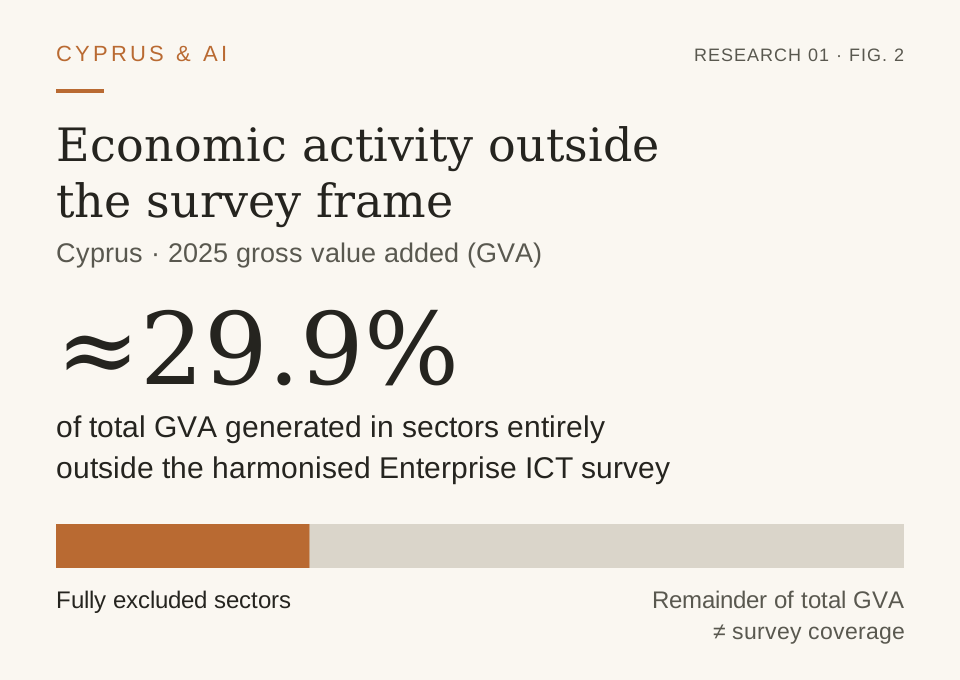
The finding gives the statistical boundary a more tangible economic dimension.
Gross value added measures the value generated by economic activities before the addition of taxes on products and deduction of subsidies on products. By examining the contribution of sectors excluded in their entirety, we can establish their weight within the national economy.
The result does not mean that 29.9 per cent of Cypriot enterprises are missing from the survey. It says nothing about the proportion of businesses using AI outside the observed population.
Nor is it a comprehensive estimate of the survey's economic coverage. Enterprises below the employment threshold are also excluded within otherwise covered sectors, while some activities are included only in part. The calculated share concerns fully excluded economic sectors alone.
These qualifications matter because the two indicators describe fundamentally different things. The AI adoption rate is a percentage of enterprises in a defined population. The 29.9 per cent expresses the contribution of excluded sectors to national gross value added.
They cannot be combined into an alternative national adoption figure.
What the calculation does establish is that substantial economic activity takes place in sectors for which this specific enterprise indicator provides no direct measurement of AI use.
Consider what that means for understanding technological change in Cyprus.
Artificial intelligence may be relevant to a financial institution, a university, a healthcare organisation or a public authority in ways that differ markedly from its applications in retail or manufacturing. The tasks, organisational requirements and potential consequences are not necessarily comparable.
Yet the exclusion of these sectors from the harmonised survey tells us nothing about how extensively they actually use AI.
Statistical absence is not evidence of technological absence.
The same caution applies internationally. European countries use a harmonised framework, and the exclusions are not unique to Cyprus. Whether they account for a larger or smaller proportion of economic activity elsewhere would require a separate comparison of national economic structures.
The Cypriot finding is narrower and more defensible. Sectors responsible for a substantial share of the country's gross value added are beyond the reach of this particular adoption indicator.
The official EU comparison remains valid within its intended scope. What becomes less defensible is treating it as a complete account of the economy's relationship with artificial intelligence.
There is, however, a second limit to what the figures reveal. It applies even to the businesses that the survey does include.
Adoption Is Not the Same as Economic Change
A national adoption rate combines businesses of different sizes and economic activities into a single figure.
Some of these differences are visible in the underlying data.
In Cyprus, 7.7 per cent of small enterprises reported using AI technologies in 2025, compared with 15.3 per cent of medium-sized enterprises and 35.1 per cent of large ones.
Larger businesses also report higher adoption rates across the European Union. But Cyprus remains below the corresponding EU27 figure in each of the three size classes.
This is an important qualification to the idea that the national difference might simply reflect an economy containing many smaller companies.
Enterprise size may contribute to the aggregate result, but differences remain within the measured size categories. Their relative importance, alongside sector composition and other influences, cannot be established without further analysis.
The industry breakdown introduces additional variation. Businesses operate under different conditions, perform different tasks and face different requirements when introducing new technologies.
A single national percentage inevitably compresses that diversity.
But the more consequential limitation concerns what adoption itself tells us.
Imagine two businesses that both report using artificial intelligence.
One employs an AI application to assist employees with routine administrative work. The other has integrated AI-supported processes across several functions, changing how information is assessed, how tasks are organised and how operational decisions are prepared.
Both may count as AI users under the survey's headline indicator.
Their experience of the technology could nevertheless be very different.
This is a hypothetical illustration, not a claim about the practices of named Cypriot companies. It exposes the distance between recording the presence of a technology and understanding the changes associated with its use.
A business may adopt an AI application without substantially changing its operations. Another may reorganise established processes around new capabilities, requiring different skills, responsibilities and management arrangements.
The distinction is not necessarily between successful and unsuccessful adoption. A narrowly defined application may be valuable precisely because it solves a limited problem efficiently. Extensive technological integration, meanwhile, offers no automatic guarantee of improved performance.
The question of economic value must be examined separately.
A more complete assessment would consider what the technology is used for, how employees interact with it, which processes are affected and whether measurable changes follow.
Even then, observing an improvement alongside AI use would not necessarily establish that artificial intelligence caused it. Organisational changes, investment, market conditions and other factors may contribute to the outcome.
This is why the adoption statistics alone cannot demonstrate a national AI-driven productivity effect.
The same applies to employment. They do not reveal whether artificial intelligence has created jobs, displaced workers or changed the requirements of individual occupations. Such conclusions require evidence designed to examine those outcomes.
Eurostat's broader statistical programme already provides more detail about technology use than the headline adoption indicator suggests. It offers a valuable foundation for further investigation. But the information needed to establish economic effects depends on the question being asked.
For business leaders, this difference has a practical consequence.
Knowing that a technology is becoming more common may help establish its relevance. It does not demonstrate whether a proposed investment will be worthwhile, whether employees are equipped to work with it or whether a company's operating model is ready to make effective use of it.
The prevalence of AI, the depth of its integration and its contribution to business performance are connected subjects. They require different evidence.
Understanding that separation is essential when the discussion moves from statistical observation to decisions.
The Questions That Follow
Cyprus's measured AI adoption gap deserves serious attention.
Within the enterprises covered by the harmonised European survey, the difference from the EU27 is substantial. It persists across company-size categories, suggesting that the national aggregate cannot be explained simply by the composition of the business population.
That is a meaningful starting point for investigating the conditions under which Cypriot enterprises introduce artificial intelligence.
But it remains a starting point.
An international comparison of technology diffusion, an assessment of AI use in the financial sector and an investigation of productivity improvements in tourism are three different research questions.
The first can draw directly on the harmonised enterprise survey. The second requires evidence relating to financial institutions, which sit outside its standard coverage. The third must examine business activities and economic outcomes, rather than relying on adoption rates as a proxy for productivity.
For an individual company, the questions become more concrete still.
What would artificial intelligence change in its operations? Which activities would benefit? What organisational capabilities would be needed? How could the business establish whether an implementation had produced the intended results?
An international adoption percentage may provide useful context for those decisions. It cannot answer them on behalf of the organisation.
The same principle applies to public institutions considering policies for digital development, education or workforce skills. Appropriate decisions require evidence matched to the economic activities and outcomes they are intended to influence.
This does not necessarily mean commissioning a new national survey whenever an existing indicator reaches the limits of its usefulness.
Cyprus already has national accounts, business statistics, labour-market data and other sources of economic information. Some questions may be addressed through more careful analysis of existing material. Others will require sector-specific research or new ways of observing how artificial intelligence is actually used.
The first task is to establish what is already known, where the evidence is incomplete and which unanswered questions have the greatest significance for economic decisions.
That is also the wider purpose of Cyprus & AI.
The development of artificial intelligence in Cyprus cannot be understood solely through the number of businesses reporting its use. The country's economic structure matters, as do differences between sectors, the organisation of work and the human expertise needed to turn technological capabilities into productive activity.
Future investigations in this series will examine these dimensions on their own terms, distinguishing observed developments from explanations, expectations and possible future outcomes.
For now, the official figures tell us something important. Among the enterprises included in the European survey, AI adoption in Cyprus remains well below the EU average.
They do not tell us that the rest of the economy is standing still. Nor do they establish how much economic value the technology has already created.
The challenge is not to replace a reliable statistic with a more reassuring story. It is to develop a better understanding of the economy that the statistic can only partly describe.
For Cyprus, the question is no longer simply how many businesses use artificial intelligence. It is what that use is changing, where those changes are taking place and how we can tell whether they are creating lasting value.
Apparatus
Sources and methodology
Enterprise AI adoption and European comparison. Statistical Service of Cyprus, Results of the Survey on the Usage of Information and Communication Technologies (ICT) and E-Commerce in Enterprises 2025, published 4 December 2025. Eurostat, The Use of Artificial Intelligence (AI) Technologies in the European Union, 2026 edition, particularly the methodology and the 2025 country and enterprise-size comparisons. Underlying Eurostat dataset: isoc_eb_ai.
Survey population. The harmonised Enterprise ICT Survey covers enterprises with at least ten employees and self-employed persons in NACE Rev. 2 sections C–J and L–N, together with group 95.1. The economic activities referred to as fully excluded in this analysis are NACE sections A, B, K, O, P, Q, R and T. Other coverage limitations arise from the employment threshold and activities outside group 95.1 in section S.
Gross value added. Independent calculation for Cyprus & AI based on CYSTAT's revised Gross Domestic Product (Production Approach), Annual, table 0610020E, updated 20 October 2026. The verified calculation uses €10,262.6 million in gross value added attributable to the fully excluded sectors against national gross value added of €34,335.9 million in 2025, both at current prices, yielding approximately 29.9 per cent. This is an independently derived measure of the economic weight of fully excluded sectors, not an official AI adoption rate or an estimate of the survey's overall economic coverage.